Skip to content
Course Content
- What is a crisis ?
- Recognising the emergence of a crisis.
- What is Crisis Management?
- What are Crisis Management Procedures?
- The Crisis Management Action Plan.
- The Crisis Management Team Roles.
- What is the role of communications during a crisis.
- Contingency Planning during a crisis.
- Integration of crisis management and business continuity.
- Introduction.
- CMT Prerequisites.
- Skills and Traits.
- Role Cards
- CEO and Business Unit Executive
- CMT Leader
- CMT Coordinator
- CMT Administrator.
- External Communications.
- CMT Spokesperson.
- CMT Communications Support
- CMT People Support Team Leader.
- Internal Communications and HR Support.
- Technical Operations.
- CMT Legal.
- CMT Finance.
- Introduction.
- Structure and Components of the Action Plan
- Making the Decision to Activate the CMT.
- Selection and Activation of the CMT.
- Initial Team Briefing.
- Implement a Planned Response.
- Assess the Latest Information.
- Manage Communications.
- Monitor and Control the Response.
- Making the Decision to Stand Down.
- Introduction.
- Emergency At A Glance.
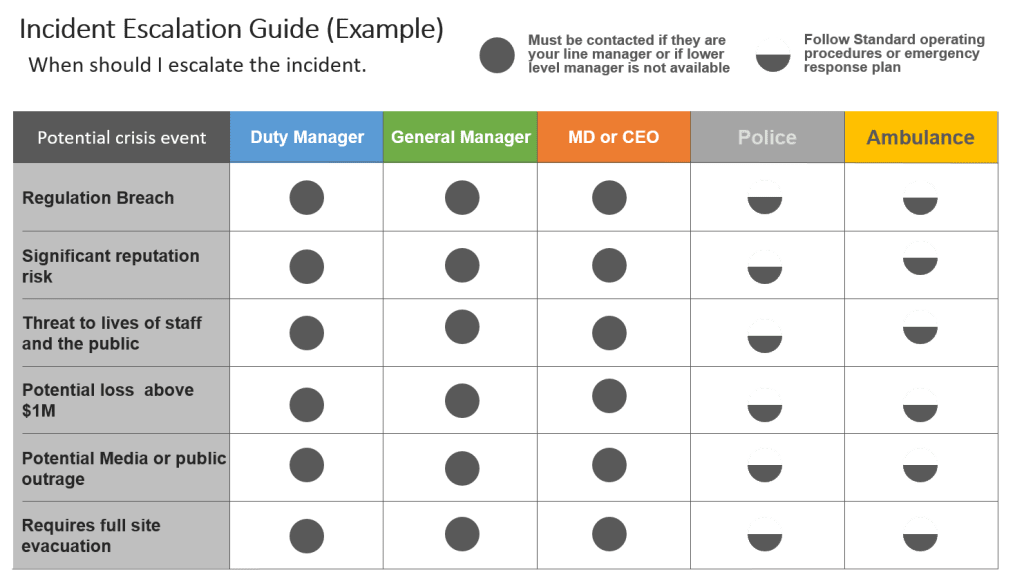
- Incident Escalation Guide.
- Incident Classification Guide.
- Escalation Flowchart.
- The First Hour Checklist.
- Stakeholder Analysis.
- Contingency Planning Guide.
- Event and Communication Logs.
- Crisis Command Centres.
- CMT Notification and Callout.
- Communications Roles.
- Communications Planning.
- Managing Stakeholders.
- Seven Rules for Media Engagement in a Crisis.
- Communicating to Minimise Public Outrage in a Crisis.
- Internal Communications.
- Influences, Followers and Inactives.
- Social Media – Pre Crisis.
- Social Media – Crisis Response.
- Social Media – Post Crisis.
- Introduction.
- Crisis Origin.
- Crisis Type.
- Organisational Infrastructure.
- Message Strategy ( in 7 parts)
- Message Form ( in 4 parts)
- Information Outcomes ( in 5 parts)
- Identifying Scenarios.
- Planning Tiers.
- Dynamic Plan Preparation.
- A Worked Example.
- Building Crisis Readiness.
- Phase 1 – Awareness Engagement.
- Phase 2 – Documentation Distribution.
- Phase 3 – Training.
- Phase 4 – Crisis Simulation Exercises.
- Phase 5 – Post Exercise Review.
- Unpacking the Exercise.
- Setting the Foundation.
- Building Success Measures.
- Shaping the Exercise.
- Tools for Effective Delivery.
- The Crisis Exercise Lifecycle.
- Practical Methods for Scenario Design.
- The Cold Debrief Report